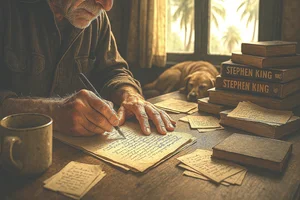
What Burns, Stays Burned
Cal Mercer did not wake up wanting to burn anything.
He woke up because the radiator knocked like it was trying to get out of the wall. He lay there staring at the ceiling of his one-room apartment, counting the cracks he had memorized years ago. He knew where every line bent. He knew which ones leaked dust when the upstairs neighbor walked too hard.
He rolled onto his side and checked his phone. No messages. No news. No reason to move yet.
He sat up anyway.
The city did not wait for people to be ready.
He made coffee that tasted like metal and old water. He drank it standing, looking out the window at a block that had learned how to decay politely. Paint peeled in clean strips. Trash collected in corners like it was afraid of the open. A man slept in a doorway across the street with his coat pulled over his face. Nobody bothered him. Nobody helped him.
Cal didn’t believe in help the way most people meant it. He believed in endings.
He put on his coat, checked the pocket where he kept his matches, and went out.
He didn’t choose buildings randomly. He chose stories.
He spent his mornings walking. He listened. He watched. He learned what people didn’t say out loud. He knew which landlord was letting wiring rot behind walls. He knew which slumlord ignored gas leaks until tenants stopped calling. He knew which businessman dumped chemicals into drains at night and paid fines like they were parking tickets.
He didn’t burn everyone.
He burned the ones who made choices and called them accidents.
That afternoon he stood across the street from the Bellweather Arms, a six-story apartment block that leaned just enough to look tired. The owner, Harold Breen, had been warned six times about fire hazards. Each time he paid the fine and raised the rent.
Two kids had died there three years ago. Space heater tipped. Curtains caught. Breen said it was tragic. Then he replaced the carpet and rented the unit again.
Cal watched people go in and out. He counted. He waited until evening, until the lights settled, until he knew who was home and who wasn’t. He didn’t want bodies. He wanted change.
When the fire finally took, it climbed fast through the trash-stuffed stairwell. It moved like it knew where it was going. Sirens came. People ran. Nobody died.
Breen lost the building. Insurance fought him. Investigators found what he had ignored. He went to court. He cried on camera.
Cal watched the news from a diner and didn’t feel proud. He felt finished.
Two days later, Detective Jonah Pike found him.
Pike didn’t wear suits. He wore the same gray coat in winter and spring and pretended summer would never come. He sat across from Cal at the diner like they were meeting for lunch.
“You’re early,” Cal said.
“You’re obvious,” Pike replied.
They ordered coffee. Neither drank much.
“You burned Bellweather,” Pike said.
“Yes.”
“You didn’t kill anyone.”
“No.”
“You could have.”
“Yes.”
Pike stared at him. “You think that makes it better?”
“I think it makes it true.”
Pike sighed. “You keep telling yourself you’re cleaning the city.”
“I am.”
“You’re lighting matches and calling it justice.”
Cal leaned forward. “You arrest people and call it closure. How’s that working out?”
Pike’s jaw tightened. “This ends with you in a cell or a grave.”
Cal shrugged. “Everything does.”
Pike left money on the table and stood. “I don’t want to chase you. But I will.”
“I know.”
That night someone else burned.
Not Cal.
The fire was wrong. It spread too fast. It climbed walls that shouldn’t have carried flame. It killed three people in a boarding house on Grant Street. The owner had been under investigation for fraud and neglect.
The news called it tragic. Pike called it suspicious.
Cal stood across the street watching firefighters drag hoses through smoke that tasted sharp and strange. He hadn’t done this. He knew his own work.
Pike found him in the crowd.
“This wasn’t you,” Pike said.
“No.”
“You’re not the only one who thinks fire fixes things.”
Cal looked at the building. “Who did this wanted bodies.”
Pike nodded. “That’s the difference.”
The second fire came four nights later. A factory closed for safety violations. Two security guards burned alive in their booth.
The third fire took a family who lived above a pawn shop owned by a man accused of trafficking stolen goods.
The city started to panic. The news called him a monster. The internet named him The Purifier.
Cal called him sloppy.
He went looking.
He found him in a burned-out church basement, painting on a piece of scrap wood. A man in his forties. Clean. Careful. Calm.
“You’re Cal Mercer,” the man said without looking up.
“You’re killing people.”
The man dipped his brush. “They’re collateral. Progress is loud.”
“You’re wrong.”
The man smiled. “You’re scared because I do what you won’t.”
Cal stepped closer. “I do what works.”
“What works is fear.”
Cal grabbed him by the collar and slammed him into a wall. “Fear doesn’t fix wiring. Fear doesn’t seal gas lines. Fear just burns flesh.”
The man laughed, coughing. “You think you’re better because you count? You still light the match.”
Cal let him go. “You don’t care who gets burned.”
“I care about the message.”
“Then you’re not fixing rot. You’re growing it.”
The man’s smile faded. “You don’t get to judge me.”
Cal left him alive.
He went to Pike.
They met under a bridge where the river smelled wrong.
“He’s painting scenes,” Cal said. “He’s making trophies. He wants the city to watch.”
Pike stared at him. “Why tell me?”
“Because he’s using my shadow. And he’s getting people killed.”
Pike exhaled slowly. “You help me catch him, and I’ll put cuffs on both of you.”
Cal nodded. “Fair.”
They baited him with a lie. A rumor about a warehouse owned by a man who had poisoned a neighborhood’s water and walked free.
The man came.
Cal watched him move through the building with practiced hands, spreading fuel without care for who might still be inside.
Cal stepped out of the dark. “Not this way.”
The man raised his lighter. “You don’t get to stop me.”
Cal lunged. They fought in smoke and sparks. The lighter fell. Fire caught.
Pike came in fast, gun raised.
The man screamed as smoke filled his lungs. “You’re no better than me!”
Cal dragged him toward the door. “I never said I was good.”
Pike cuffed him outside as the building burned behind them.
Three people lived.
Pike looked at Cal. “You’re done.”
Cal nodded. “I know.”
He turned himself in.
At trial, people called him a monster and a hero in the same breath. He said nothing. He didn’t argue.
Years later, Pike watched him walk out older, slower, quieter.
“Still think fire tells the truth?” Pike asked.
Cal looked at his hands. Scarred. Steady. “Fire tells you what’s left when lies are gone.”
Pike said, “You going to light any more matches?”
Cal shook his head. “No. I’m tired.”
The city kept rotting in new ways. It always would.
But sometimes, someone noticed.
Sometimes, someone ended something that needed to end.
And sometimes, that someone paid for it forever.