Prearranged
The first stone appeared in early March, when winter had finally loosened its grip but the ground was still cold enough to resist shovels. Old Saint Agnes Cemetery sat at the edge of town the way it always had, fenced in by rusted iron and bordered by pines that leaned inward as if listening. People drove past it without looking, the way you do with places that will outlast you.
No one saw who placed the stone.
It stood near the back, beyond the section where the older graves leaned and sank, their dates softened by rain and lichen. This stone was new but didn’t look it. The marble was gray and pitted, the edges worn smooth. Moss clung to the base. The inscription was shallow, as if it had been there a long time and weather had slowly eaten it away.
EMILY RUTH DALTON
1958 – 2025
BELOVED MOTHER
BELOVED WIFE
Emily Dalton was alive. She taught third grade. She sang in the choir every Sunday and brought lemon bars to potlucks. She noticed the stone on a Tuesday afternoon when she was walking the cemetery with her sister after visiting their parents’ graves.
Her sister laughed at first. People laugh when the world misbehaves in small ways.
“That’s creepy,” her sister said. “Some kind of prank.”
Emily didn’t laugh. She stood with her arms folded, staring at the name. The birth year was right. The spelling was right. Even the little cross carved at the top matched the one on her parents’ stones.
The date was wrong.
She reached out and touched it. The stone was cold. Damp. Solid.
“Let’s tell Father Collins,” her sister said. “He’ll know what to do.”
Emily nodded, but she didn’t move. She felt something in her chest, not pain exactly, more like the quiet certainty you get when you realize you’ve missed an exit and there’s no place to turn around.
That night she dreamed of rain falling on stone. Endless rain. Washing everything smooth.
By the end of the week there were three more.
The cemetery committee noticed first. They were a quiet group of retirees who met once a month in the church basement to discuss lawn maintenance and burial plots. No one remembered approving a new section. No paperwork existed. The land records showed nothing.
The new stones were spaced evenly, as if measured. All of them weathered. All of them bearing names of people who lived within town limits. A grocer. A high school guidance counselor. A man who ran the hardware store and unlocked it every morning at six.
All alive.
The dates were close. All ended the same year.
Word spread slowly, then all at once.
People walked the cemetery in the afternoons, pretending it was curiosity, pretending it was concern for history or vandalism. They told themselves it was a prank that had gotten out of hand, some tasteless art project or sick joke.
But no one could explain how the stones were made. Or how they were placed without tracks. Or how no one heard anything at night.
The sheriff came. He was a thin man with a soft voice who didn’t like trouble. He took photographs and shook his head and said he’d call the state. The state never called back.
Someone suggested removing the stones. That idea died quickly. No one volunteered.
Emily Dalton stopped singing in the choir.
She started checking her body for signs. Bruises. Lumps. Fatigue. Every ache felt louder now, like it was announcing itself. She went to the doctor twice in one week. Blood work came back clean. The doctor told her to rest, suggested stress.
She didn’t tell him about the stone.
At church people sat farther apart. They spoke in low voices. The sermons grew softer, then sharper. Father Collins spoke often about preparation, about humility. About the difference between knowing the date and knowing the hour.
One Sunday, during communion, a woman fainted.
More stones appeared.
Always overnight. Always already old.
Some people stopped going to the cemetery. Others went every day, walking the rows with their breath held, scanning names, hoping not to find themselves. Some found neighbors. Some found relatives. One man found his own.
He stood in front of it for a long time before sitting down hard in the grass. His wife tried to pull him away. He wouldn’t move. He kept touching the date with his fingers, as if it might come off on his skin.
He died three months later in a farming accident. A clean break. Tractor rolled on wet ground.
The date on the stone was correct.
That’s when the town stopped pretending.
The grocery store closed early. The hardware store stopped unlocking at six. Children were kept inside after dark. People began leaving lights on at night, as if light could hold something back.
The cemetery grew.
No announcement was ever made. No fence added. No sign posted. It just kept expanding inward, like a mouth closing.
Emily’s stone stayed where it was. Waiting.
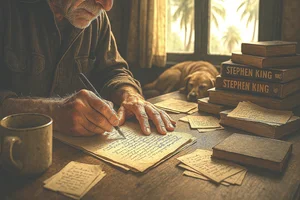
She started writing letters. To her husband. To her students. To no one in particular. She filled notebooks with small memories. Recipes. Apologies. Things she hadn’t said because there always seemed to be time.
Her husband tried to talk sense into her. He told her stones didn’t kill people. He told her fear was contagious.
Then his name appeared.
He didn’t tell her right away. He went alone. He stood there and read it until the words lost shape. He didn’t touch it.
That night he dreamed of earth pressing down on his chest.
After that, they stopped making plans.
The doctor calls came less often. Emily didn’t push anymore. She already knew the shape of the end. It wasn’t violent. It wasn’t sudden. It was a narrowing.
People tried to leave town. Some did. Their stones still appeared. Dates unchanged.
A rumor spread that the stones marked the moment you were meant to be remembered, not the moment you would die. That they were measuring something else. Faith. Regret. Weight carried too long.
No one liked that theory.
The first grave opened on its own in April. Just a shallow collapse, like the ground had exhaled. Inside was nothing. Just dark soil and water.
The next one wasn’t empty.
The body matched the stone. Older than it should have been. Skin gray and slack. The face familiar in a way that made people step back.
The man was still alive.
The grave was filled in before sunrise. No one spoke of it openly. But everyone felt the line move closer.
Emily woke one morning unable to catch her breath. Not pain. Pressure. Like the air had thickened overnight. She sat on the edge of the bed and waited for it to pass. It didn’t.
At the hospital they ran tests. She watched the nurse’s face change as numbers came back wrong.
She asked for the date.
The nurse didn’t answer.
Emily was buried on a Thursday. The ground was soft by then. Rain had been steady all week.
The stone was already there.
No one questioned it.
The town kept going. That was the strangest part. School continued. Church continued. The cemetery grew until it reached the fence, then somehow kept growing anyway.
People learned not to look too far ahead. Learned to live in the narrowing.
And the stones kept appearing. Quiet. Patient. Already worn smooth, as if they had been waiting a long time to be read.