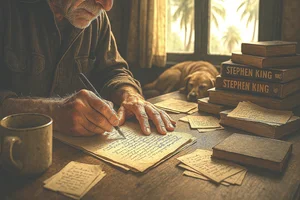
Thomas Calder
He was formidable, this man amongst men. 6’6” and solid, not an ounce of fat on him, as if Jack Reacher had manifested himself from the page to the city streets. And he would not be taken alive.
That part mattered. It had always mattered. It was not bravado or reputation. It was policy. The kind you make with yourself after the first time you see what happens when you hesitate.
We knew him before we knew his name. Everyone did. He passed through rooms and left them quieter. Not because he demanded silence. Because people stopped talking when he arrived. You could feel the air tighten. Conversations shortened. Decisions got made faster.
Thomas Calder never announced himself. He did not need to.
That night, the rain had turned the industrial district into a mirror of broken light. Everything reflected badly. Streetlamps bled into puddles. Warehouse windows stared back like blind eyes. The river moved slow and dark, swollen with runoff and trash and things that did not float back up.
We watched him step out of his car and stand for a moment, letting the rain soak him. No hurry. No nerves. He wore the same coat he always did, heavy and dark, collar turned up. Not for style. For habit.
He had received the call an hour earlier. No number. No explanation. Just a location and a time. That should have been enough to make anyone walk away.
Calder almost did.
Almost.
The message had been wrong somehow. Not the words. The space between them. A hesitation where there should not have been one. Whoever left it had been afraid, and fear did not belong on Calder’s line.
He checked his pistol, then slid it back into place. Muscle memory. Comfort. The knife at his side felt heavier than usual, like it was aware of what it might be asked to do.
We felt him before he felt us.
The dock lights flickered once, then steadied. The smell of wet metal and algae hung thick in the air. Somewhere, water dripped in a slow, patient rhythm. This place had been empty for years, but emptiness is rarely empty.
Movement near the loading bay. Calder did not turn. He never did.
“Come on,” he said, voice low, flat. “You’re not hiding as well as you think.”
Footsteps answered. Measured. Careful. Someone trying to sound calm.
A man stepped into the light. Average in every way that mattered. Clean clothes. Clean hands. Smile that arrived a second too late.
“You’re bigger than I expected,” the man said.
Calder looked at him then. Took him in. Cataloged the mistakes.
“You’re here because you’re scared,” Calder said. “That makes this a bad idea.”
The man laughed, but it cracked halfway through. “This isn’t about fear. This is a courtesy.”
Calder felt it then. The shift. The way the night leaned closer.
“Courtesy from who.”
The man’s smile pulled wider than it should have. Skin stretched. Something underneath rearranged itself.
“From what.”
The lights died.
Not dimmed. Not flickered. Gone. The dock vanished, the river vanished, even the rain seemed to lose its sound. Darkness pressed in, thick enough to feel.
Calder moved, stepping back, weapon up, breath steady. He had trained for this. For chaos. For surprise. He had not trained for the wrongness that flooded the air.
Something laughed.
Not the man. Not one thing. Many.
“You always come,” the voices said. “We counted on that.”
The smell changed. Earth. Old blood. Rot that had never seen daylight.
Calder fired. The flash tore the dark open for an instant.
The man was still there. But so were others.
Too many. Pressed together. Shapes that borrowed pieces of people and forgot to return them. Limbs bent badly. Faces unfinished. Eyes that reflected the light with hunger.
The bullet hit the man square in the chest. He staggered, surprise flickering, then relief.
“Thank you,” he said, and fell.
The others surged.
Calder emptied the magazine. Flash after flash. The dock burned into his eyes in fragments. Mouths opening too wide. Hands reaching. Bodies that did not react the way bodies should.
They did not bleed.
They did not fall.
They learned.
Calder backed toward the edge of the dock, boots slipping on wet concrete. His options collapsed one by one. This was not a fight. It was an invitation.
“You were supposed to stop,” the voices said. “You were supposed to lie down.”
He laughed, harsh and raw. “I don’t do that.”
The knife came free, steel singing softly. Honest weight. Honest work.
The first shape lunged. He met it. The blade sank into something dense, resistant, then slid free. The thing recoiled, more offended than injured.
Its face shifted.
It became someone Calder knew.
A partner. A friend. A man who had not made it home.
Calder froze for half a heartbeat.
Hands grabbed him. Too many. Cold. Strong. They dragged him down. His back hit concrete hard enough to steal his breath. Something bit into his shoulder, not teeth, something sharper.
“This is where you belong,” they said. “You already know how to disappear.”
Pain burned white. Calder fought anyway. Elbows. Knees. Teeth. He broke something. Heard it crack. The weight on him shifted, corrected, adapted.
He reached inside his coat. Found the small device taped there. The thing he carried for exactly this reason.
Not as a weapon. As a refusal.
His thumb hovered.
The darkness seemed to wait.
“I don’t go quietly,” Calder said.
Light erupted. Not brightness. Force. Heat. Sound that flattened everything. The dock vanished. The rain screamed.
Then nothing.
Morning came slow and gray.
They called it an electrical fire. Old infrastructure. Neglect. The riverfront had been overdue for something like this. Clean jackets took notes. Tape went up. Nobody asked too many questions.
There were no bodies. No clear point of origin. Just fused metal and scorched concrete that looked wrong if you stared at it too long.
The area stayed closed. Dogs balked near it. Rainwater vanished into cracks that had not been there before.
Some nights, people said the place felt crowded.
A patrol officer swore he saw a tall man standing near the ruins during a storm. Broad shoulders. Coat collar turned up. Not moving. Just watching the river.
He blinked. The figure was gone.
The report mentioned fatigue.
Stress.
Nothing further.
But when the rain comes down hard enough, when the city goes quiet and the river swells, there is a sense of attention beneath the concrete. Not anger. Not hunger.
Recognition.
And somewhere in that quiet, something remembers a man who refused to stop, and a question it still does not have an answer to.